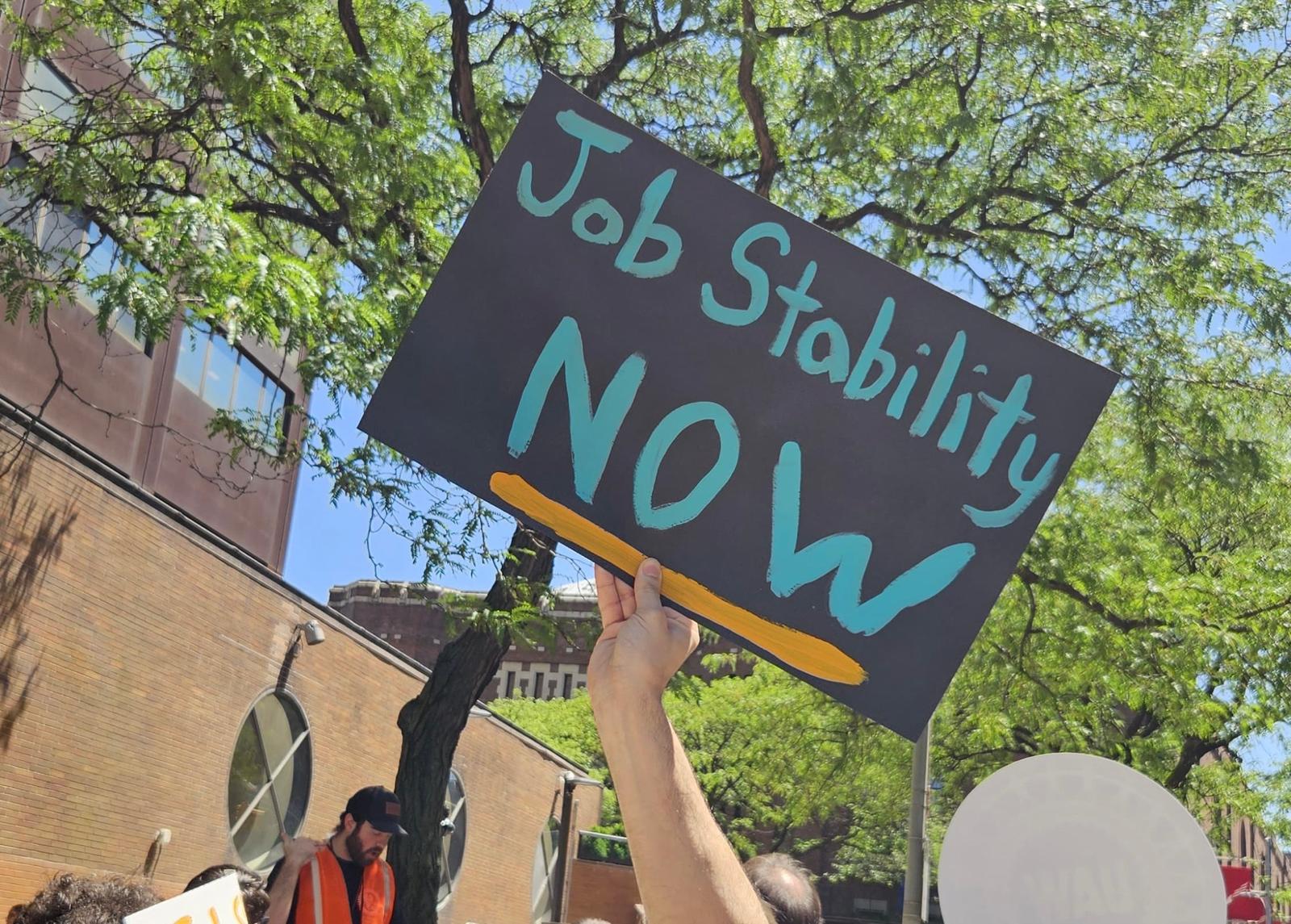
Bargaining Updates: Columbia continues to drag feet on economics, more movement needed on workplace rights

After voting overwhelmingly to authorize a strike if one becomes necessary, Postdocs/ARS joined a membership meeting last week to discuss next steps toward a fair agreement!

We met with the Columbia administration for our 14th and 15th bargaining sessions in the past three weeks. First, after receiving feedback in our July CPW membership meeting and through numerous conversations on the ground, our bargaining committee brought a new package proposal to Columbia.

In the package, we reintroduced a housing stipend for all postdocs/ARS not living in Columbia housing, addressing the critical need to relieve rent-burden workers with direct support from Columbia. We also made movements in several areas where we thought we could continue working toward an agreement, reached a tentative agreement on the relocation payment side letter, and reasserted language in several proposals (more details below).

After our membership voted by an overwhelming 90% to authorize our bargaining committee to call a strike if circumstances justify, we joined Columbia again at the bargaining table on August 24th. At the session, Columbia withdrew their proposal to cap vacation day payouts for postdocs/ARS who leave the institution. Their proposal also included a minor change to International Employees in regards to requesting information about work authorization, a side letter linking to Columbia’s policy regarding interactions with law enforcement on campus, and language that would increase the Childcare FSA amount in the instance that Columbia increases it for other Officers of Research.

If Columbia understands the level of frustration so many of us feel, they should be prepared to make more meaningful progress at our upcoming bargaining sessions. We are scheduling another session with Columbia on September 10th and have agreed to have a neutral third party mediator join the session at the request of the administration in an effort to make more progress. Please take a moment and RSVP here to join us at the table.

Finally, the more of us involved in organizing and talking to our colleagues about bargaining, the stronger we will be. If you’re interested in helping or joining one of our Organizing Committee meetings, please fill out this form.

You can follow the negotiations in detail on our public bargaining tracker here. Here are some details on our proposals on August 11th:

  • On Compensation, we maintained a $80k minimum for postdocs and $92k minimum for ARS, with 3.5% anniversary raises, but reduced the increase in new starting salaries for 2027/28 from 3.5% to 3%.

  • On Childcare, we reduced the age eligibility for the FSA from 13 to <6, but maintained an increase from $5k to $7.5k to reach the new federal cap.

  • On Housing, we re-introduced a housing stipend of $2500 per year for employees not residing in Columbia Postdoc housing.

  • On Appointments, we removed the additional raises for short term reappointments, but maintained restrictions on reasons for short appointments with union consultation.

  • On Vacations, we proposed to cap vacation day payouts at 40 days, moving towards Columbia’s proposals to cap at 15 days.

  • On Relocation Benefit, we agreed to strike the word “relocation” from the side letter proposed by Columbia, and increase the amount from $1500 to $1800.

  • We reasserted our previous proposals on Non-discriminationTransitUnion Access & RightsHardship Fund, and International Employees.

Here are details on Columbia’s proposals on August 24th:

  • Columbia withdrew their proposal to cap vacation day payouts in the Vacations article.

  • On Childcare, Columbia added language that would increase the Childcare FSA amount for postdocs/ARS in the instance that they increase it for other Officers of Research.

  • On International Employees, Columbia added language stating that the University would make reasonable efforts to identify outstanding work authorization information upon request. They also added a side letter linking Columbia Policy for interactions with ICE on campus.

  • Columbia reasserted their language in all other areas.

Solidarity,

Philip Creamer, Physiology and Cellular Biophysics
CPW-UAW 4100 Bargaining Committee

CPW Members Vote 90% Yes to Authorize a Strike!

The results from our Strike Authorization Vote (SAV) are in! Postdocs and Associate Researchers resoundingly support authorizing our Bargaining Committee to call a strike if necessary to reach a fair third contract.

  • 🗳️ A supermajority of CPW members voted and voted YES.
  • ☑️ 86% of CPW membership, 846 postdocs and Associate Researchers voted, the highest number of CPW members to vote in an SAV since we formed our union.
  • 🔥 90.2% of voters voted YES (763 votes).
  • 📝 58 non-member postdocs and ARSs filled out support forms for the strike authorization, bringing the total number ready to support a strike to reach a fair contract to 821, more than 50% of all postdocs and ARSs.

Our SAV sends a clear message to the Columbia administration: we do not wish to strike, but if they continue to stonewall a fair contract, we will grind the research functions of the University to a halt if necessary. Not only do we provide the bulk of Columbia’s research labor that makes it a world class research institution, we also secure the funding that makes this research possible. Now is the time for the administration to meet our reasonable demands for dignified compensation, guaranteed maximum length DS-2019 for international workers, the enhancement of the hardship fund and childcare supporthousing stipends, stronger protections for one year appointments, adequate notice for contract renewal, and the ability to directly bring cases of discrimination and harassment to a neutral third-party arbitrator. These would all make Columbia more stableequitable and competitive, and would be easy for the University to afford (see flyer below).

Let’s take a look at how we got here:

  • We began negotiations for this contract with management nearly five months ago. To date, they have refused to make meaningful movement on our priorities and have even demanded concessions from our union. Their proposed minimum salaries and annual raises are effective pay cuts accounting for inflation while the majority of postdocs at Weill Cornell and Mount Sinai now earn salaries above $80,000. The administration also wants to introduce new limits to our unused vacation payouts.
  • Worse still, management continues to violate labor law and commit unfair labor practices (ULP), most notably withholding information on our bargaining unit members that is critical for our union to represent them.1 2 3

We are holding a Unit Membership Meeting this Thursday, August 27th at 5pm to discuss next steps now that we voted yes to authorize a strike. We will discuss how to demonstrate to Columbia’s Administrators that we will not stop unless they meet our demands for a fair third contract and which actions to take next. RSVP here to join.

Our next scheduled Bargaining Session is Monday, August 24th, from 1pm to 5pm. Please click here to RSVP for the session.

In solidarity,

CPW-UAW 4100 Organizing Committee
CPW-UAW 4100 Bargaining Committee

CPW-UAW Post-Strike Authorization Vote Membership Meeting | Thursday August 27th at 5:00PM

RSVP here for our crucial Post-SAV Membership Meeting

The bargaining campaign continues! In the past month we have opened the Strike Authorization Vote (SAV), which wraps up this week, and had a bargaining session. Despite this, Columbia continues to drag their feet at the bargaining table.

To understand the current state of bargaining, continue to discuss priorities as bargaining evolves, and plan next steps please join us at our monthly CPW membership meeting on Thursday, August 27th at 5:00PM. We will discuss the results from the Strike Authorization Vote (SAV) that will end on August 21st, what our next steps should be, and the future of our current contract campaign.

Agenda:

  • Normal union business

  • Updates from the bargaining committee

  • Discussion of Strike Authorization Vote (SAV) results

  • Next steps for bargaining campaign

Please RSVP at the link here.

Locations:

  • CUMC, Todd Auditorium

  • Morningside, Fairchild 700

  • Zoom

Food will be provided.

Now is the time to show up, speak out, and fight for a stronger contract. Join and bring your co-workers.

In solidarity,

Cameron Kyle Foltz
Postdoctoral Research Scholar
CPW-UAW Local 4100 Bargaining Committee

Report Back from the 2026 UAW Constitutional Convention

To ensure that you receive a ballot for the upcoming elections, update your contact info here

Under the theme of “Our Generation’s Defining Moment”, 846 delegates from 302 Local Unions gathered last month for the UAW Constitutional Convention. Delegates made historic decisions that will help chart the future of our Union; setting priorities to strengthen worker power and meet the challenges ahead.

Local 4100 Constitutional Convention Delegates President Andrew Little, Kaitlin Murtha, and Clauvis Yengo on the floor of the 39th UAW Constitutional Convention.

Constitutional Convention Highlights:

  • Delegates voted to pass a  financial package of constitutional amendments including:

    • Allocating $100 million to help workers form their unions, including thousands of unorganized academic workers in NYC

    • Expanding our Strike and Defense Funds to $1.3 billion so all UAW workers can take on our employers

    • Increase strike pay to $550/week so that workers can hold the line if our employer leaves us no choice but to go on strike

  • Expanded the definition of “retiree”

  • Fund the UAW Women’s Department

  • Establish New Local Standing Committee: LUCA

  • Divest UAW funds from remaining Israeli Bonds

  • Spanish translation of UAW Constitution (2022 UAW Constitution in Spanish available here)

In addition, delegates passed versions of  the following resolutions, which we submitted after our membership voted overwhelmingly to support in April:

Click here to see a detailed day-by-day report from the Convention.

During the Convention, delegates nominated candidates for UAW International Executive Board (IEB). Brandon Mancilla was re-nominated for Region 9A Director and won by acclamation. A number of candidates were also nominated for UAW International President, Secretary Treasurer, and three Vice Presidents.

All members have the right to vote directly for these officers and ballots will be mailed out in late August.

Update your home address herehttps://form.jotform.com/262110242871144

Online forums for the International President, Secretary Treasurer, and Vice President positions can be watched on YouTube here.

In Solidarity,

Local 4100 Joint Council

Strike Authorization Vote | July 10 Membership Meeting Recap

Last Friday, colleagues from across campuses joined our membership meeting to discuss where bargaining currently stands. It was clear that the current proposals from Columbia do not meet the needs and priorities members have consistently raised.

You can find a side-by-side comparison of our proposals and their offer linked here.

Members discussed what it will take to move Columbia at the bargaining table. At the meeting, a motion was presented to open a Strike Authorization Vote (SAV). An SAV is the process through which members can authorize our Bargaining Committee to call a strike if necessary). All attendees were in favor and we voted to open the SAV in conjunction with the expiration of the contract – tonight, July 15th. Therefore, unless an agreement is reached by tonight, all Columbia Postdoctoral Worker members will receive a link to the ballot around 10 AM, and a vote will be open to authorize a strike. 

The next few weeks will be decisive in determining the kind of contract we win. A strong and rapid turnout in the SAV will demonstrate our collective power at the bargaining table. Every vote matters. Every click matters. Every conversation with a coworker about the SAV matters.

We encourage you to vote as soon as the SAV opens, and talk to your coworkers about voting. You can learn more about what a Strike Authorization Vote is, how it works, and what it means for our union on our website: Learn more about the SAV. You can contact us with any questions at postdocunion@uaw4100.org.

The contract we win depends on the power we show now. Let’s show Columbia that CPW members are united and ready to fight for the contract we deserve.

In solidarity,

Sarah Vincent
CPW-UAW Organization Committee
Postdoctoral Research Scientist in the Department of Population and Family Health

Bargaining Updates: After two-week contract extension, Columbia argues for no retroactive raises

We started off Tuesday, June 30th, the day of our contract expiration, with an energizing rally on Haven Plaza! Over 200 postdocs and ARS attended and we had speeches from several members and allies, including Democratic congressional candidates Brad Lander, Claire Valdez, and Darializa Avila Chevalier! Immediately following the rally, we held a marathon bargaining session with the University that began with our bargaining team making a counter package offer.

We made significant movement in our package in the interest of reaching of an agreement before our contract expired, but after several hours of deliberation, the University countered with only minor increases in the minimum salaries, insufficient solutions on major issues like job instability, additional money in the hardship fund to be used over the lifetime of the of a 4 year agreement effectively further reducing the significance of this movement. We stayed late into the evening and made our best attempt at reaching an agreement with the University, offering a second counter package proposal, but the University did not reciprocate.

At the end of the session, Columbia’s team offered a two week extension of our current contract to allow for additional time to reach an agreement, as well as third party mediation. We accepted the two week extension but declined mediation at this time, because we believe there is still progress to be made by bargaining directly with the University.

Here are some details on our counter proposals on June 30th:

  • On Compensation, we proposed $80k minimum for postdocs and $92k minimum for ARS, with 3.5% anniversary raises.

  • On the Hardship Support Fund, we proposed $2 million dollars and $5000 per person per year.

  • On International Employees, we reasserted much of our language and moved to 10 days for visa renewal and down to $2,500 on visa renewal fee reimbursement.

  • On Appointments, we proposed modified, narrow exceptions for short reappointments and decreased the raises granted to postdocs/ARS who receive short reappointments.

  • On Non-discrimination, we reasserted language in several areas while making movement on accepting some of the University’s language on anti-bullying.

  • We reasserted our previous proposals on ChildcareHousing, and Transit, and Union Access, Rights.

Here is a summary of Columbia’s proposals:

  • On Effective Date & Duration of the contract, Columbia proposed for the contract to be 4 years rather than 3 years, extending the amount of time before we can renegotiate our working conditions again.

  • On Compensation, Columbia proposed just $73,588 for postdocs minimums and $80,914 for ARS, with a 3% anniversary raise in the first year.

  • On Hardship Support Fund, Columbia proposed a $1,000,000 for the life of the four-year contract.

  • On Appointments, Columbia responded with a Side Letter on “Regarding Reappointments” about convening a working group to discuss reappointments.

  • On Parking and Transportation, Columbia also responded with a Side Letter about convening a working group regarding transportation and shuttle services.

We held another bargaining session with the administration on July 8th, and the only substantive change Columbia made in their package counter proposal was to argue for NO retroactive raises, meaning that raises would only take effect once our contract is ratified. Between this and the 4-year contract proposal Columbia continues to make movements that do not address the biggest concerns of postdocs/ARS.

We are bargaining again today, July 14th at 1pm in Studebaker to reach an agreement before the two year extension expires. Please take a moment and RSVP here to join us at the table.

Solidarity,

Anna Yoney, Genetics & Development
Sam Seidman, Psychiatry
CPW-UAW 4100 Bargaining Committee

Bargaining Updates: Our response to Columbia’s latest “comprehensive” offer

In their “comprehensive” offer two weeks ago, Columbia rejected several of our proposals and made minor economic movements, while neglecting to engage on important workplace rights like job security and non-discrimination protections. As a whole, their new offer still fell far short of addressing the most pressing challenges postdocs/ARS face. Since then, we have worked on a response that re-asserts our priorities while making reasonable movement and agreements where possible.

In our 9th bargaining session this past Monday, we responded to their offer with a package proposal of our own in an attempt to continue making progress toward an agreement before our contract expires on June 30th, five days from today. Proposing this in the form of a package allows us to retain the right to make different proposals in the future, including reasserting positions we previously proposed, should Columbia not accept the package. We spent most of Monday’s session discussing and walking Columbia through the offer.

We fully reasserted our proposals on Parking & TransportationVacationsUnion Access, Rights & Activity, pending further information and reasoning from Columbia. Here is a breakdown of where we made movement as part of the package:

  • Compensation: We proposed a minimum salary scale starting at $85,000 for postdocs and $104,000 for ARS, with 4% anniversary raises, and reasserted language that would ensure time spent as Postdoc Fellow counts toward the two-year waiting period for the retirement benefit.

  • Housing: We reasserted our previous language around expanding access to Columbia postdoc housing and improving transparency while proposing to not include the housing stipend, making clear this movement depends on Columbia providing economic support in other areas of the contract to address the extreme housing burden postdocs/ARS face in NYC.

  • Appointments: We reasserted much of our previous proposal while including narrow exceptions for reappointments shorter than one year related to funding and work authorization, and proposed additional compensation be provided to any postdoc/ARS who is placed on a short reappointment to account for the precarity and stress that comes with that instability.

  • International Employees: We reasserted much of our previous proposal while agreeing to alter and consolidate language around visa sponsorship and support from the ISSO in an attempt to address considerations raised by the ISSO in a previous session, and proposed 12 days of visa renewal leave.

  • Non-Discrimination: We proposed having the right to grieve (appeal to a neutral third party arbitrator) when postdoc/ARS facing discrimination or harassment are not provided with sufficient interim measures. We also proposed to include the University’s new definition of bullying in the contract with a clear timeline for the process to address bullying.

  • Childcare: We fully reasserted our language to increase the Childcare FSA to the federal cap of $7,500 and proposed to not include language memorializing the current backup care program should Columbia accept this offer.

  • Hardship Support Fund: We proposed $2,500,000 for the Hardship Fund with a disbursement amount of $7,500 per postdoc/ARS and agreed to broaden what can be covered to “appointment-related expenses” after hearing from Columbia that this would cover immigration related expenses.

  • Leaves of Absence: We proposed increasing parental leave to 12 weeks without our previously proposed language on sick leave in response to considerations about other forms of medical leave provided to postdocs/ARS.

In the session, Columbia’s team continued to insist we focus negotiations solely on compensation, though suggested some movement could be made on workplace rights and protections. They also insisted on comparing Columbia to institutions outside of New York City rather than peer institutions within the city that are outpacing Columbia on both compensation and workplace rights, like Mount Sinai and Weill Cornell Medicine. We emphasized that this package represents meaningful attempt to reach an fair agreement that addresses the biggest challenges postdocs/ARS face, should Columbia choose to accept.

We remain committed to reaching an agreement by June 30th, and believe that is possible if Columbia continues to join us at the bargaining table. The University has still not responded to our request for more bargaining dates before the contract expires. For now, our next scheduled bargaining session is TODAY (Thursday), June 25th at the Medical Center. Please RSVP here to join us!

Solidarity,
Ankit Roy, Biological Sciences
CPW-UAW 4100 Bargaining Committee

Bargaining Updates: Columbia makes minor economic movements while refusing to engage on housing, job stability

We met Columbia’s bargaining team on Friday, June 12th for our 8th bargaining session. The University brought another package proposal, which included some minor economic movement and little movement elsewhere. When we asked about proposals they did not respond to in their package, including Housing, Transit, and Leaves of Absence, the University’s answer was NO – they are completely rejecting our proposals for these articles. They also insisted that we focus negotiations on compensation, despite major workplace rights like job stability and non-discrimination protections being left unaddressed by their responses.

Here is an overview of the University’s proposals – you can find the full proposals in our public bargaining tracker here:

  • On Compensation, Columbia is moving from 2% annual raises for all three years, to 2% this year and 2.5% in 2027 and 2028 – still down from the 3% anniversary raises we received in 2024 and 2025. They are proposing annual increases of the minimum postdoc/ARS salaries for 2027 and 2028, but capped at 1% per year, down from 1.5%. Minimum salaries for 2026 remain frozen at current levels.

  • Their offer on Relocation Assistance remains at $1,750, up from $1,500.

  • On the Hardship Fund, they have proposed $600,000 for three years, up from their previous proposal of $575,000. This is still very far from what is needed based on usage in the previous rounds. They are proposing to raise the disbursement amount per person per year from $5,000 to $6,000.

  • On Vacations, they moved their proposed cap on payout for unused vacation days from 10 days to 15 days.

  • On International Employees, little has changed from their previous proposal. They are continuing to insist on only 2 days of paid leave for visa renewal. They have increased the visa fee reimbursement amount from $1,250 to $1,400.

  • On Childcare, the University reintroduced the side letter from our current contract that sets the amount of the childcare FSA at $5000.

    At the session, we heard a testimonial from Manuel Beiran, a postdoc at the Zuckerman Institute and new parent, that underscores why the University should raise the childcare FSA to the new federal limit of $7500 and increase the length of parental leave. Manuel told the University’s team, “I love my work and feel fortunate to be part of Columbia’s research community, but no researcher should have to choose between having a family and maintaining financial stability. Those of us postdocs who have young children are especially vulnerable to the high cost of childcare and the loss of income that comes with parental leave.”

  • On Non-Discrimination, their response includes language on a new University procedure to deal with bullying and power-based harassment, something we have been advocating for since before our first contract. However, their proposal provides NO timeline for the process, reasserts language that would make the process for addressing discrimination and harassment longer, and no clear avenues for seeking interim measures, leaving vulnerable postdocs/ARS with insufficient protections. To emphasize why we are advocating for clear and faster timelines and better protections in the form of interim measures, we heard a testimonial from a former postdoc Yunfu Shen. Yunfu’s testimonial described the discrimination and bullying he and his wife experienced when notifying their PI that they were expecting their first child.

We presented counters on Vacations and Transit in an attempt to address some concerns raised by the University:

  • On Vacations, we included language that Employees should be encouraged to take vacation and that they will be notified of unused vacation days 60 days in advance of their appointment end date. We reasserted that there should be no additional caps on the number of unused days that can be paid out beyond the current contract language.

  • On Transit, we added that shuttle services be maintained at ‘approximately’ the current levels to address the University’s concerns that minor changes in the shuttle service might cause issues due to the nature of operation.

We will be bargaining again tomorrow, June 22nd at 2PM in the Studebaker Building and Thursday, June 25th at CUIMC. Please RSVP here to attend!

Solidarity,

Anna Yoney, Genetics and Development
CPW-UAW 4100 Bargaining Committee

Bargaining Updates: Columbia makes minimal movement in first of back-to-back sessions

In our 6th bargaining session, we pressed Columbia to justify their refusal to bargain over critical economic proposals, such as Housing, Childcare, and Transit, and we brought a counter on Vacations to show we’re serious about reaching a deal. Columbia responded with another package proposal that included minimal movement, while continuing to insist on a freezing minimum salaries and cuts to guaranteed annual raises.

We communicated plainly and directly that while we appreciate the small movement the University is making in certain areas, these movements do not add up to a fair contract, and the clock is running out before our agreement expires. Here are some of the details on where they moved:

  • On International Employees, Columbia partially accepted our language allowing premium processing fees when employment is at risk, but rejected protections against unreasonable denials, leaving significant inequities for postdocs.

  • On Union Access Rights & Activity, Columbia accepted our language on protected time for union orientations.

  • On Vacations, Columbia moved off their opening position. They had wanted to cut the payout for unused vacation from the current 23 days down to just 5. Their latest package caps the end-of-appointment payout at 10 days — still less than half of what’s in our current contract.

In the interest of showing good faith, we gave Columbia a counter on Vacations: we reasserted the current language on the number of days and accepted the University’s language on a more standardized documentation process.

To our disappointment, Columbia continues their refusal to engage on issues that are highly impactful to our reality living in NYC:

  • Housing: the single largest expense most of us face, consuming up to 50-60% of a postdoc’s salary even in Columbia housing. Columbia says it won’t put a single word about housing in our contract.

  • Transportation: including the Fort Lee shuttle that members fought to save. Columbia insists on retaining the right to cut shuttles as needed – effectively shifting financial burdens on to workers.

  • Childcare: Columbia wants to strip the specific subsidy amount out of the side letter and has stated it has no intention of increasing it.

  • Leaves of absence: we proposed 16 weeks and a fairer eligibility threshold. Columbia maintains that the current language is “sufficient.”

Of the other economic proposals they previously offered, including freezing postdoc/ARS minimums and cutting anniversary raises from 3% to 2%, Columbia’s package did not include any movement. Instead they insisted that these reductions are a generous offer, despite this being an effective pay cut given record increases in inflation, and unacceptable to members financially struggling in one of the most expensive areas of the country.

We will continue fighting for every one of these priorities. But what happens at the table depends on what we do away from it. Every inch Columbia has given, we won by mobilizing. This is proof that the pressure works and the way we close the rest of the gap.

We will be bargaining again this Monday at 1:30pm in Hammer building Room LL207, please RSVP here to attend!

Solidarity,

Daniel Savran, Preventive Medicine
CPW-UAW 4100 Bargaining Committee

Bargaining Updates: WAGE FREEZE! Columbia proposes a step backward with economic proposals

Over 100 postdocs and ARSs rallied at Haven Plaza last week to demand Columbia work with us, not against us in reaching a fair contract.
The Columbia administration responded to some of our economic proposals in last Thursday’s session, including compensation, hardship support fund, and relocation assistance, while effectively rejecting our proposals on childcare, housing, leaves of absence and transportation. As a whole, their responses were utterly inadequate to address the economic challenge postdocs and ARS face, and on compensation were a major step backward from what we have previously established in our agreements. Our bargaining committee provided counterproposals on non-economic articles including Appointments, International Employees, Non-Discrimination, and Union Rights & Access. In the session, we spent much of the time discussing changes we made to these proposals to address concerns they had previously raised.

It’s clear we need to keep the pressure up on Columbia to win both the non-economic and economic improvements we deserve, as Columbia’s proposals suggest they are not yet serious about finding solutions to some of the major crises facing researchers. RSVP here for our next scheduled bargaining session and click here to sign our job security petition if you haven’t yet.

Join us at the bargaining table:
📍 Studebaker 469
📅 Thursday, May 28
🕛 12:00 PM

Here are some of some details on economic counter proposals Columbia put on the table:

  • Compensation: Columbia proposed to freeze first year postdoc and ARS minimums, eliminate one-time salary adjustments based on experience, and to cut anniversary raises from 3% to 2%. At a time when the cost of living in New York City continues to outpace inflation adjustments across the board, Columbia is proposing to give us less, not more.
  • Hardship Support Fund: Columbia proposed to increase the hardship fund from $500,000 to $575,000 – a 15% increase to a fund that is already insufficient for a unit of our size as we saw when we exhausted the fund six months ago. They also proposed language intended to respond to our Immigration Support Fund proposal by broadening qualifying expenses in the Hardship Support Fund.
  • Relocation Payment: Columbia proposed a $250 increase to the one-time payment for newly hired employees, while removing “relocation” from the name of the side letter.

Columbia effectively rejected four articles that address some of the most pressing concerns our members face:

  • Childcare
  • Housing 
  • Transit
  • Leaves of Absence

What we brought to the table

In contrast, here are details of what we presented:

On Appointments, we reasserted our demand for 12-month minimum appointments and reappointments. Short-term contracts create enormous instability: financial, personal, and professional. Columbia’s response was to cite the need for “institutional flexibility”, meaning the University wants to retain the ability to unilaterally give postdocs short contracts. To illustrate what that actually looks like, Sergey Pampou, an ARS from Systems Biology, shared his experience of navigating a 3-month appointment and the financial stress and uncertainty of the period, including the impossibility of planning his future. This is not flexibility, it’s precarity.

We also reasserted our position that postdoctoral fellows must not be classified as independent contractors for tax purposes. This classification strips fellows of benefits that every other member of the unit receives and Tess Forrest, a postdoc in the Department of Psychology, walked the room through exactly what that means in practice: lost benefits not just during employment at Columbia, but lasting consequences that follow fellows into their future careers. This is not a technicality, it is a material harm that Columbia has the power to solve at the bargaining table.

On International Employees, we proposed that postdocs be able to request premium visa processing when delays threaten their employment and that such requests should not be unreasonably denied. We reasserted the need for 15 days of paid time off for visa renewal against Columbia’s current offer of 2 days as well as a higher reimbursement amount for visa renewal costs, all grounded in data and testimonials from international members of our unit. We replaced our original language on immigration safety with language directly tied to the University’s existing Public Safety protocols in an effort to reach workable language around immigration protections for researchers.

On Non-Discrimination, we reasserted that our need to grieve harassment and bullying cases is essential for securing swift and effective interim measures for postdocs/ARS who are experiencing any form of harassment. We accepted the additional protected categories the University proposed and reasserted categories present in our current contract that were left out of the University’s recent counterproposal. We also proposed the University’s current working definition of bullying, which our members gave significant input into in 2022-23, in place of the website link referencing the definition. Finally, we accepted the University’s proposed change that leaves it to the discretion of the employee to notify the Union regarding cases involving Title IX.

On Union Access, Rights, & Activity, we proposed that union representatives be given 20 minutes to present at OPA orientations in order to inform new postdocs of the contract and their rights, which is the status quo practice. We reasserted our proposal for Columbia to include demographic and personal contact information in the monthly bargaining unit list, while removing one item. We cannot effectively represent a unit we cannot fully reach.

What are the next steps?

Columbia’s proposals suggest they are not yet ready to bargain seriously on compensation, benefits, or the quality-of-life issues that define whether Columbia is a place where postdocs and research can thrive. The gap between what they are offering and the needs of postdocs and ARS remains wide.

The most important thing postdocs and ARS can do right now is stay engaged, talk to our colleagues, and get involved in the campaign. Columbia needs to understand that researchers are paying attention and will not accept a contract that leaves us behind.

In solidarity,
Ankit Roy, Biological Sciences
CPW-UAW Local 4100 Bargaining Committee