
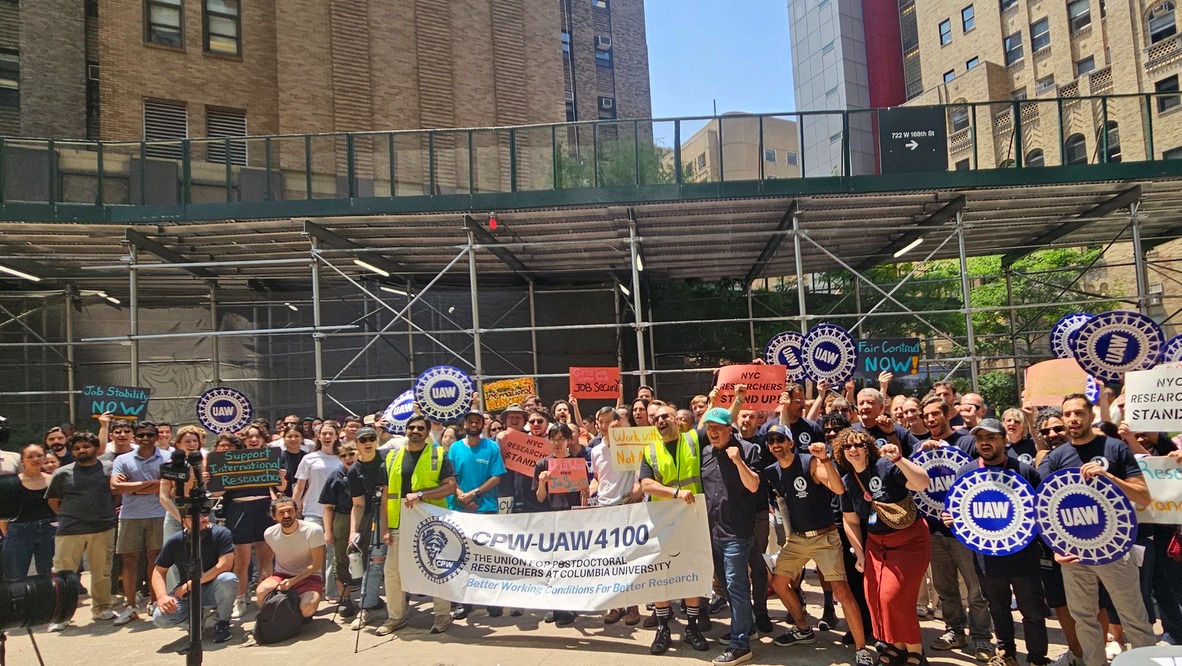
1. Why are we considering a strike?
We made it clear at the start of negotiations that our goal was to increase job security for researchers at Columbia and to address the cost of living crisis affecting all of us. We aim to better support Columbia’s research mission and our own life-saving research by improving our working conditions.
Any fair agreement must address the affordability crisis for our members, secure our appointments in the face of funding uncertainty, and provide real protections for international workers, Fellows, and those facing discrimination, harassment, and bullying. While we want to avoid having to go on strike, we need to demonstrate to Columbia that our work is essential, and that they cannot deny us adequate compensation or basic workplace rights.
We have delivered majority petitions, talked to the media, organized protests, fought for federal and state funding for months now. Despite these and other efforts, as of July 15, the administration has barely acknowledged many of our key proposals, making very little movement in recent sessions.
2. What is a Strike Authorization Vote?
This is a vote that authorizes our bargaining committee to call a strike if circumstances warrant. Approval from a ⅔ majority of those voting is required for authorization. It is a standard process within the union to ensure that this step is taken with full participation and approval from the bargaining unit before we consider calling a strike.
3. Who is eligible to vote on strike authorization?
Members in good standing with the UAW International Union are eligible to vote on strike authorization. That means if you pay membership dues to CPW-UAW 4100, you are eligible to vote. If you are not yet a member, sign up here so that we can build power together and improve our workplace.
4. When is the strike authorization vote open?
The Strike Authorization Vote will open on July 16, 2026 in the event that a tentative agreement is not reached by expiration of our contract on July 15.
5. How does a strike authorization vote work (is it anonymous?)
A strike authorization vote is used to authorize the bargaining committee to call a strike in the circumstance that Columbia refuses to bargain fairly. This vote requires a ⅔ approval rate from union members in order to pass. The vote is conducted via digital secret ballot. Only the CPW Elections Committee and the Organizing Committee will have access to information about who has voted, but not how members have voted.
6. What has led up to considering a strike authorization vote and a potential strike?
We made it clear at the start of negotiations that our goal was to increase stability for researchers at Columbia and to address the cost of living crisis affecting all of us. We aim to better support Columbia’s research mission to advance knowledge, attract and retain world-class talent, and compete with peer institutions by improving our working conditions. We have been active in fighting the cuts to research funding for the same reasons.Throughout negotiations we have made many efforts to demonstrate the urgency of reaching a fair agreement in a timely manner, including:
- A majority of researchers signed an open letter calling on Columbia to reach an agreement in a timely manner that addresses key job security needs.
- We have shared our stories through social media and testified in bargaining about our experiences of harassment and unfair termination.
- We adjusted our work schedules in order to join bargaining sessions
- We have traveled to Albany multiple times, protested funding cuts and met with elected representatives at the state and federal level to discuss the urgency of funding academic research
- We held town halls and multiple rallies with alongside NYC academic workers across the city and here at Columbia
- We have shown support and engaged our colleagues and community about the issues that matter most to us
- We held a Contract Expiration Rally attended by more than 200 researchers and allies, including 3 Democratic Nominees for Congress.
- We held a mass meeting at which nearly one hundred postdocs and ARS from across Columbia voiced support for a strike authorization vote.
Despite these and other efforts, as of July 15, the administration has barely acknowledged many of our key proposals, making very little movement in recent sessions.
While we have made progress in a number of important areas since we started bargaining at the end of March, Columbia has so far failed to reach a fair agreement in a timely manner, and continues to resist agreeing to stronger protections in areas like appointment security, anti-discrimination, harassment, and bullying, and International Workers’ Rights.
In addition, Columbia proposes no more than a 2% one-time increase to the minimum salaries for postdocs and ARS, and under 3% yearly raises after the first year of the new agreement. Columbia still refuses to agree to ANY provisions on Housing and Transit.
7. Am I allowed to vote on the SAV and strike if I am an international postdoc?
International postdocs and ARS have the same rights under labor law to participate in union activities, including striking, as domestic workers do. Thousands of international postdocs at Mount Sinai, the University of California and the University of Washington took strike votes and ultimately went on strike to win strong contracts in the past few years.
8. Will I be paid while I am on strike?
Columbia has the right to not pay us while we are on strike and not working. In the event of a strike, postdocs/ARS who complete strike duties will be eligible for $550 per week of strike pay from the UAW strike fund (untaxed, but it is taxable income). We also have the option to establish a hardship fund and fundraise to provide further assistance to workers who experience emergency financial hardship due to lost pay.
9. How do I access strike benefits?
As members of UAW, Columbia Postdocs/ARS have access to UAW’s Strike and Defense Fund after losing pay for participating in a sanctioned strike. Strike benefits are $550 per week in strike pay, along with medical benefits in the event that Columbia withholds healthcare benefits. Please note that only CPW-UAW 4100 members in good standing will be eligible for strike benefits.
10. Where and when would a strike take place?
Once we have voted to authorize a strike, that is a determination we will make together.
11. What could a strike look like/how long would it last?
A strike is a complete work stoppage. During a strike, Postdocs/ARS would not perform our work duties and instead would participate in picket lines to increase the visibility of the strike. We will make the decision about ending a potential strike based on the status of negotiations.
12. What is a picket line?
A picket line is a public expression by striking workers of their dispute, which conveys a request for other workers and community members to join them in solidarity. We can increase the impact of a strike by encouraging colleagues and community allies to not cross the line and avoid activities that weaken our strike.
13. What makes a strike effective (why will Columbia care)?
Columbia cannot run without us. Postdocs and ARS make up the largest group of researchers working in labs at Columbia. When we withhold our labor, Columbia will be forced to make much greater efforts to reach a fair agreement or cease to function as a top tier research institution. The more of us who participate, the more collective power we will have.
When we demonstrate publicly that we are withholding our labor through picket lines and pressure from community and political allies, it will also increase pressure on Columbia to respond to our demands.
14. What do I do instead of work if we go on strike?
During a strike, Postdocs and ARS would participate in various strike duties including picketing in and around campus, talking to coworkers, outreach to allies, and strike coordination efforts.
15. Is it legal for us to go on strike?
Yes.
As with all other union action, our solidarity and willingness to be public is our best protection: there is strength in numbers. We’ll work to support each other and work with our elected leadership and other representatives to navigate legal or other challenges as they arise.
16. Will I get in trouble for striking?
Retaliation for organizing and striking is illegal. Additionally, as with all other union action, our solidarity and willingness to be public is our best protection. In other words: they’d have to take on all of us in order to take on one of us.
17. Am I allowed to strike if I am an international postdoc?
International postdocs and ARS have the same rights under labor law to participate in union activities, including striking, as domestic workers do. Thousands of international postdocs at Mount Sinai, the University of California and the University of Washington took strike votes and ultimately went on strike to win strong contracts in the past few years.
18. Can CU withhold my healthcare benefits if I’m on strike?
If Columbia decides to withhold health benefits during a strike, postdocs/ARS would have our medical benefits paid through the UAW Strike and Defense Fund.
19. Why should I vote yes on the strike authorization vote (SAV)?
A strong yes vote tells the University that unless they reach a fair agreement with us, we have the power to grind its research operations to a halt. This gives management a strong reason to quickly negotiate a fair contract with us.
20. Isn’t going on strike only hurting ourselves because our research would suffer?
While participating in a strike will require all of us to make sacrifices, this action also gives Postdocs/ARS the collective power to ensure that Columbia reaches a fair agreement with us. A contract that provides vital improvements to our pay, benefits, and workplace rights would also make Columbia more equitable, inclusive, and competitive with other major research institutions, and this will in turn improve our research at Columbia.
21. What should I do with my live test subjects if we choose to strike?
It’s ultimately Columbia’s responsibility to make sure that any basic lab maintenance happens during a strike. There are also ways that you can prepare for a potential strike. These plans could include advance-planning your experiments or informing supervisors that they may need to make alternative plans to take care of these subjects.
22. If we strike, will advance notice be provided?
Yes.
23. Can my visa/immigration status be put in jeopardy (now or in the future) for exercising my right to strike?
No, Columbia cannot retaliate against you for exercising your right to participate in lawful concerted activity, including striking, in any aspect of your relationship with Columbia. Striking has no bearing on your visa or immigration status and is not considered political activity.
24. Can my application for legal permanent residence be in trouble if I participate in the strike?
No, striking does not jeopardize or delay applications for legal permanent residence. Thousands of workers at Mount Sinai, the University of California and the University of Washington have participated in strikes without any reported instance of delay or rejection of applications as a result of participating in a strike.
25. How can I get more involved?
If you are not yet a member, sign up here. If you already are a member, contact us here and an organizer will get in touch with you.
26. What if I have more questions?
Please send any additional questions here or talk to a local steward.